
For grown-ups to read with children
Do owls have ears? Owl facts to share with kids
By Ollie Ocean · Published 1 November 2026
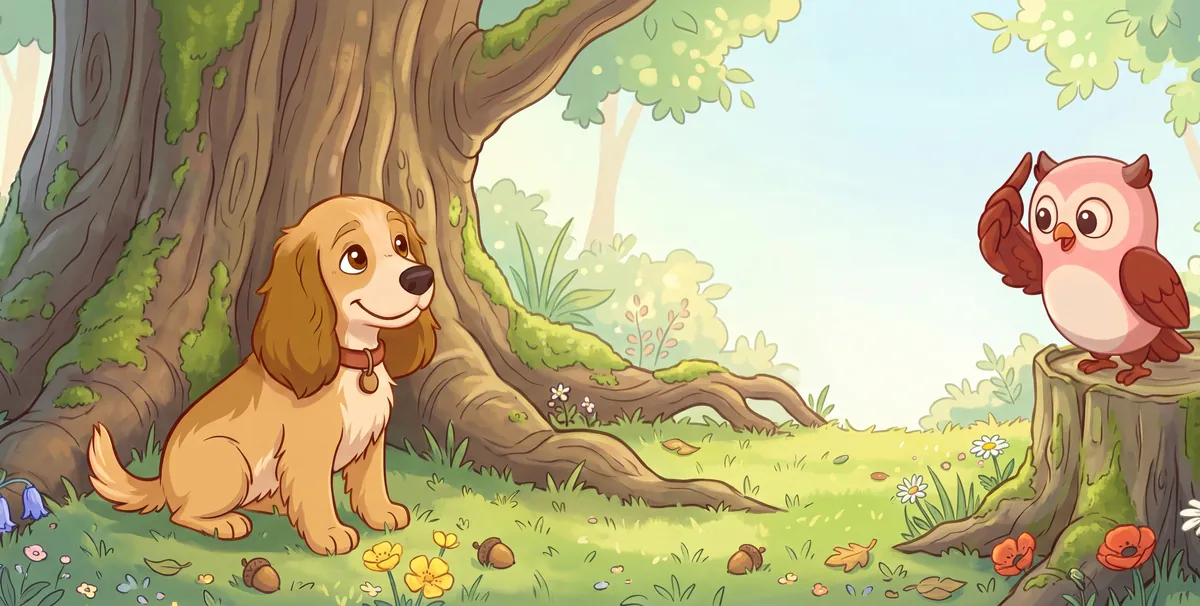
In Three Paws: How We Met, Luna the young owl is sure the two feathery tufts on her head are her ears. Niko isn't so sure. So who's right? Here are the facts behind the book's "Did you know?" page, plus a few more to share with children aged 4 to 8.
We checked every fact here against the sources listed at the end. There are many kinds of owls and they vary a lot, so when something is true of only some owls, we say so.
Yes, owls have ears
An owl's ears are openings on the sides of its head, just behind the eyes. You can't see them, because they're hidden under the feathers.
Try this: before you tell your child, ask where they think an owl's ears are. If they point to the top of its head, they're in good company. So does Luna.
So what are the tufts on top?
The pointy "ears" that some owls have are tufts of feathers. They have nothing to do with hearing. Owls use them to help camouflage themselves. Not every owl has them: owls without tufts are called round-headed owls.
So in the book, Niko is right. Luna's tufts are feathers, and her real ears are hidden at the sides of her head.
Why one ear can sit higher than the other
In many owls, the two ear openings aren't level: one sits a little higher than the other. Because of this, a sound reaches each ear slightly differently, and that helps the owl work out exactly where the sound is coming from, up or down as well as left or right.
Barn Owls are a well-known example. Other owls have ears that sit level, like ours.
A face that gathers sound
Many owls have a ring of feathers around the face, called the facial disc. It collects sound and funnels it toward the hidden ears. On a Barn Owl's heart-shaped face, it works rather like our outer ears do.
Try this: cup your hands behind your ears and listen to a quiet sound, like a ticking clock or rain outside. Then take your hands away. Does it sound different? An owl's facial disc does a similar job all the time.
Hunting by ear
Owls are experts at working out where a sound is coming from. An owl can pinpoint a rustling mouse and pounce, even if it hasn't seen it. Barn Owls can hunt on the darkest nights using only their hearing, and Great Gray Owls are sometimes seen catching small animals that are moving about under a layer of snow.
Big eyes that stay still
An owl's eyes are tube-shaped, not round eyeballs like ours, and they can't move around in their sockets. So to look to the side, an owl turns its whole head.
Owls have 14 bones in their necks, twice as many as people, and they can turn their heads about 270 degrees. That's three-quarters of the way around, but not all the way.
Try this: ask your child to keep their eyes looking straight ahead and turn only their head to see something beside them. That's how an owl looks around.
Night owls, mostly
Most owls hunt at night, which is why Luna gets sleepy in the daytime. Their large pupils help them see in the dark. But owls aren't blind in daylight, and some kinds, like the Ferruginous Pygmy-Owl, hunt in broad daylight.
Wings that whisper
Many owls fly almost silently, thanks to special feathers. The front edges of their wing feathers have a stiff fringe, like the teeth of a comb, and the back edges have a soft, hair-like fringe. The feathers also have a velvety surface that soaks up the noise they make as they slide over one another.
Feet, not paws
Luna is right about this one. Owls have feet, with four toes on each. Two toes point forward and two point back, and an owl can swing one of its back toes forward to help it grip and walk. Each toe ends in a long, sharp claw called a talon.
Not every owl hoots
Some owls hoot, but not all of them. Barn Owls make hissing sounds, and Eastern Screech-Owls have a call that sounds like a horse's whinny.
Owl pellets
Owls swallow their food whole or in big pieces, without chewing. The parts they can't digest, such as fur and bones, are packed into a tight bundle called a pellet, which the owl later brings back up.
Baby owls are owlets
A baby owl is called an owlet. Young owls often spend time on the ground while they learn to fly, so an owlet on its own isn't always in trouble. If you find one and you're worried about it, ask a local wildlife rescue for advice before touching it.
Owls around the world
There are more than 200 kinds of owls, and they live almost all over the world, in nearly every kind of habitat on land.
And what about Shelly's tail?
The book's "Did you know?" page has a squirrel fact too. A tree squirrel's bushy tail helps it balance as it runs and climbs, and can act like a rudder when it jumps. In cold weather, gray squirrels curl up and use their tails as a blanket to keep warm.
Read it with Luna
Luna's ear mix-up is on pages 16 to 19 of Three Paws: How We Met, a read-aloud picture book for ages 4 to 8, coming soon in paperback. When you read it together, stop on those pages and see if your child remembers where an owl's ears really are. Then check the "Did you know?" page at the back.
For more questions and activities, see the How We Met reading guide, or meet Luna and her friends.
Sources
Checked on 1 November 2026.
- Owl Research Institute: Owl adaptations
- National Audubon Society: 13 fun facts about owls
- British Trust for Ornithology: Owl hearing
- The Barn Owl Trust: A Barn Owl's amazing powers of hearing
- Animal Diversity Web, University of Michigan Museum of Zoology: Strigiformes (owls)
- Wisconsin Department of Natural Resources: Owl (Keep Wildlife Wild)
- Woodland Trust: Grey squirrel
- Smithsonian's National Zoo: Prevost's squirrel